
Medical Career in Germany
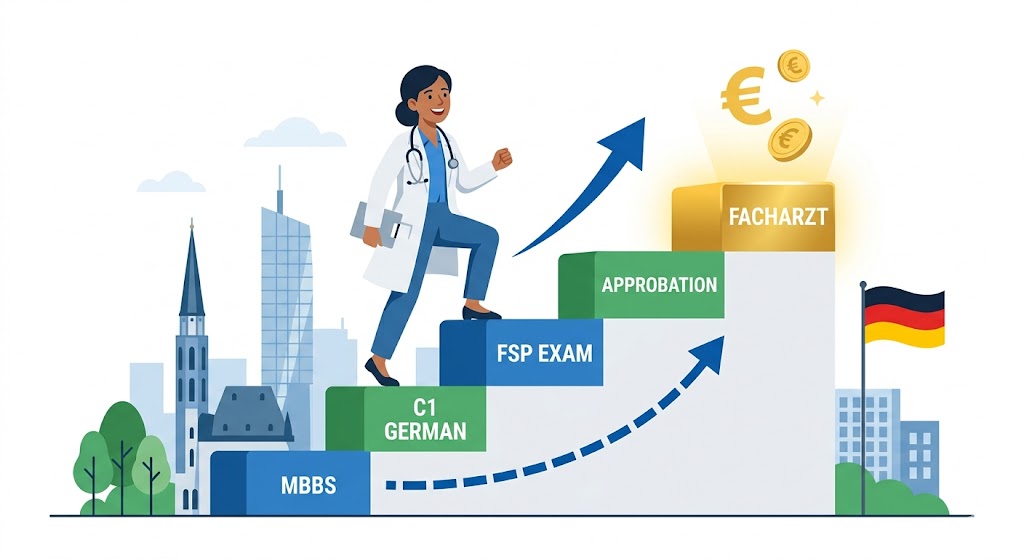
Complete 2026 Residency Guide
Bypass the immense pressure of the NEET-PG system. Discover the structured, fully salaried pathway to achieving your medical specialization (Facharztausbildung) in Germany.
Key Takeaways for 2026
- Duration: 4 to 6 years, depending entirely on your chosen clinical specialty.
- Entry Protocol: No competitive entrance exams like NEET-PG. Your focus shifts to language mastery, clearing the knowledge exam (KP if mandated), and securing your Approbation.
- Compensation: Start earning immediately. Base salaries range from approximately €4,850 to €6,340 gross per month during residency, supplemented by lucrative on-call shifts.
- Market Demand: As outlined in our recent market analysis, Germany urgently needs foreign doctors in 2026 to sustain its healthcare system.
- The Ultimate Goal: Passing the Facharztprüfung to earn the highly respected, EU-recognized board certification.
In the German healthcare framework, a medical PG or residency is officially termed the Facharztausbildung. Board certification is known as the Facharzttitel. Only after completing your mandated hospital training and passing the final oral board examination can you legally practice as an independent specialist.
At MedGermany, when we consult with MBBS graduates internationally, we treat "residency," "PG," and "Facharztausbildung" as synonymous terms representing the exact same journey. The terminology changes, but the goal remains the same: world-class clinical specialization.
Through our extensive experience providing a clear, doctor-led roadmap for Indian MBBS graduates, we have identified several life-changing advantages over the grueling NEET-PG preparation cycle:
Discover more about the unparalleled lifestyle and career benefits on our comprehensive Why Germany guide.
Success requires strategic sequencing. We advise all our applicants to rigorously organize the following prerequisites in order:
A critical error many applicants make is underestimating the duration of surgical and internal programs. You must plan your finances, language acquisition, and support systems accordingly. Below is the official breakdown of training durations by specialty.
Biochemistry (Biochemie), Physiology (Physiologie), Anatomy (Anatomie).
Family Medicine, Anesthesiology, Ophthalmology, Obstetrics & Gynecology, ENT, Dermatology, Human Genetics, Pediatrics, Child & Adolescent Psychiatry, Microbiology/Virology, Nuclear Medicine, Neurology, Pharmacology, Phoniatrics, Physical & Rehabilitative Medicine, Psychiatry & Psychotherapy, Psychosomatic Medicine, Radiology, Forensic Medicine, Radiotherapy.
Transfusion Medicine, Urology, General Surgery, Vascular/Cardiac/Pediatric/Plastic Surgery, Orthopedics & Trauma Surgery. Core Internal Medicine including subspecialties: Angiology, Endocrinology, Gastroenterology, Hematology & Oncology, Cardiology, Nephrology, Pneumology.
You will train as an Assistenzarzt under the direct supervision of certified specialists in university, regional, or private network hospitals. Your clinical progression is meticulously tracked against the official training catalog and recorded in a physical or digital Logbuch.
Every rotation, ultrasound, surgical procedure, and intensive care shift must be documented and signed off by your supervisor. This documentation discipline is non-negotiable. At our consultancy, we coach doctors to adopt a "log as you go" mentality to prevent administrative bottlenecks prior to their final board exams.
As a highly realistic planning frame for 2026, resident doctors generally see base salaries starting around €4,850 gross per month in Year 1, scaling up to roughly €6,340 gross per month by Year 5 or 6.
Crucially, this base figure does not include on-call payments, night shift supplements, weekend allowances, or occasional department bonuses. Actual compensation depends on your specific hospital wage agreement (Tarifvertrag) and your monthly duty roster. We actively assist our clients in deciphering these contracts to accurately model net take-home pay after taxes and social insurance deductions.
To view the entire structured workflow of this process, explore our complete Medical Residency Roadmap. Below is the essential progression:
It requires four to six years depending entirely on your chosen discipline. Pre-clinical fields are shorter, whereas surgical and internal subspecialties consistently require 72 months of logged clinical practice.
You will reside in Germany for the duration of your training. However, residents are entitled to approximately 30 days of paid annual leave. Many of our candidates structure their duty rosters to accommodate one or two extended trips to their home country per year. Planning is key: call schedules dictate your flexibility, so coordinate family events well in advance.
Beyond the residency base of €4.8k to €6.3k per month, achieving your Facharzttitel unlocks consultant-level compensation, performance bonuses, and highly lucrative private practice opportunities that significantly multiply your lifetime earnings.
In our dedicated one-on-one consulting work with international doctors, the candidates who succeed fastest are those who plan early, select their target federal state strategically, and prepare for exams with clinical simulations rather than basic grammar drills. Explore more success strategies on our News and Insights page.
If your absolute goal is a medical residency in Germany without the constraints of NEET-PG, your success in 2026 hinges on clinical language mastery, an impeccable application file, and state-smart sequencing. Let us build a time-bound, precise plan tailored to your profile.
Prefer email? Contact our team directly to get started.