Medical and Dental Career in Germany
Does Germany Need Foreign Doctors in 2026?

Does Germany Need Foreign Doctors in 2026?
2026 Doctor Shortage & Career Pathway
Yes, Germany still needs foreign doctors in 2026. But the opportunity is best understood as a structured licensing and employment pathway, not as a shortcut. For Indian MBBS doctors, the winning strategy is German language, FSP, KP/Approbation planning, local clinical exposure, and realistic hospital targeting.
Quick Answer
Germany needs foreign doctors in 2026 because the healthcare system is facing a combined pressure of aging doctors, rising patient demand, outpatient coverage gaps, and uneven regional distribution. Foreign-trained doctors are already part of the German system, but candidates still need German language, FSP, Approbation or Berufserlaubnis, and often the Kenntnispruefung. The shortage creates opportunity; preparation converts that opportunity into a real job.
Article at a Glance
- Main answer: yes, Germany needs foreign doctors, especially in regional hospitals, outpatient care, general medicine, internal medicine, emergency-related services, and underserved areas.
- Best audience fit: Indian MBBS doctors who are ready to learn German seriously and follow a structured licensing route.
- Biggest mistake: thinking the shortage replaces Approbation, FSP, KP, documentation, and German clinical communication.
- Best next step: use the Medical PG in Germany roadmap to map your language, documents, exam, visa, and hospital strategy.
The 2026 Data: Why Germany Still Depends on International Doctors
The discussion about foreign doctors in Germany is not theoretical. Germany already has a large number of international physicians in the system, and official data shows that this dependence has grown over the last decade.
- Foreign doctors are already part of the system. Destatis reported that 64,000 doctors in human and dental medicine, around 13%, had no German citizenship in 2024. Ten years earlier, this was about 30,000.
- Many immigrant doctors are younger. Destatis also noted that almost half of foreign doctors were younger than 35 in 2024, compared with a much smaller share among German doctors. This matters because Germany is replacing an aging workforce.
- The working physician base is aging. The German Medical Association reported that more than 23% of working doctors were older than 60 in 2024, and more than 40,000 doctors were already older than 65.
- Outpatient care has a retirement problem. KBV reported that 33.7% of self-employed outpatient physicians were 60 or older. This is one reason family medicine and outpatient care remain important long-term opportunities.
- Recognition rules are changing. Germany passed a 2026 law intended to make recognition procedures for foreign health qualifications more digital, more uniform, and less bureaucratic. The direct Kenntnispruefung route becomes more central for many third-country applicants.
Sources used: Destatis, Bundesaerztekammer, KBV, BMG.
Why the Doctor Shortage Exists
Germany does not need foreign doctors for one simple reason. It needs them because several pressures are happening at the same time.
1. The physician workforce is aging
Many experienced doctors are approaching retirement. This creates pressure in clinics, outpatient practices, and rural regions. When older doctors retire, the loss is not only one person. The system loses years of experience, leadership, and patient continuity.
2. Patient demand is rising
Germany has an aging population. Older patients usually need more regular care, more specialist follow-up, more chronic disease management, and more hospital services. This increases demand for doctors even if the total number of physicians rises slightly.
3. The shortage is uneven by region
Berlin, Munich, Hamburg, Cologne, and other highly desired cities may still be competitive. Smaller cities, regional hospitals, and underserved districts often have more realistic entry opportunities for foreign-trained doctors, especially after FSP or with a strong pathway toward Approbation.
4. Medical work patterns have changed
Modern doctors often choose different work-life arrangements than previous generations. More part-time work, more employment instead of private practice ownership, and more administrative burden can reduce the available physician time even when the number of registered doctors looks stable.
5. Germany cannot fill every gap domestically
Training new doctors takes many years. Expanding medical school seats helps, but it cannot immediately replace a large retiring workforce. This is why international doctors remain a structural part of Germany's healthcare solution.
Important Reality Check
The doctor shortage does not mean Germany is easy. It means Germany has a need for qualified, licensable, German-speaking doctors.
A candidate who has B2/C1 German, clean documents, FSP preparation, realistic state selection, and a hospital strategy is in a very different position from a candidate who only says, "Germany needs doctors, so I will get a job." The first candidate is preparing for the German system. The second is hoping the shortage will do the work.
What This Means for Indian MBBS Doctors
For Indian MBBS doctors, the Germany opportunity is attractive because it offers a different model from the Indian postgraduate bottleneck. In India, many doctors spend years preparing for NEET PG, competing for limited seats, and facing uncertainty around specialty, location, and cost. Germany's model is different: specialty training is typically employment-based and salaried.
This is why many Indian doctors search for "Medical PG in Germany after MBBS." Strictly speaking, Germany does not run a classic Indian-style MD/MS seat system. The German route is Facharzt training: you work as a doctor in a hospital department, complete supervised specialty training, and later appear for the specialist exam. You are not buying a postgraduate seat; you are entering a licensing and employment pathway.
The shortage improves the logic of this pathway, but it does not remove the steps. You still need German language, documentation, state application, FSP, KP where required, and Approbation. If you want a full overview, start with the Medical PG in Germany roadmap.
Germany Doctor Shortage: What It Does and Does Not Mean
| It Means | It Does Not Mean |
|---|---|
| Foreign doctors are needed in the system. | Every applicant gets accepted automatically. |
| Regional hospitals may be more open to international candidates. | Big-city university hospitals are easy to enter. |
| German language is a high-value skill. | English is enough for clinical work. |
| FSP/KP preparation should be started early. | You can wait until arrival and figure everything out later. |
| The process is predictable if planned correctly. | The process is identical in every Bundesland. |
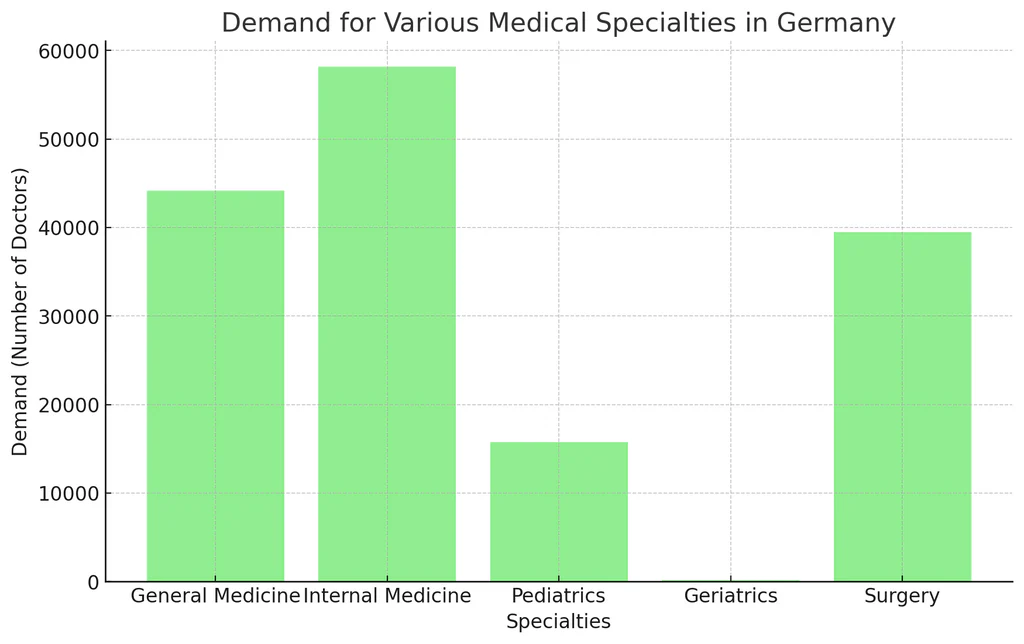
Where Foreign Doctors Are Most Needed
Demand is not equal everywhere. A successful Germany strategy means understanding where your profile is more likely to match real hospital need.
Family medicine and outpatient care are under long-term demographic pressure, especially outside large city centers.
Regional hospitals often need residents in internal medicine, geriatrics, gastroenterology, cardiology-linked rotations, and acute care.
Demand is linked to hospital duty rosters, operating rooms, intensive care, and emergency coverage.
Aging population and mental health demand create recurring need in many areas.
Entry opportunities are often better outside the most competitive metro centers.
These areas can be more open to doctors who are serious about integration and long-term work.
Which Hospitals Should Foreign Doctors Target?
Many candidates start by dreaming only of university hospitals. That is understandable, but it is not always the smartest first move. Your first German clinical role should build credibility, licensing progress, and local references.
Municipal and regional hospitals
These hospitals often provide the most realistic entry route for international doctors. They need doctors for daily ward work, emergency coverage, internal medicine, surgery, geriatrics, and other departments. They can also offer strong hands-on exposure.
Private hospital groups
Groups such as Helios, Asklepios, Sana, and others operate many regional hospitals. Some locations are highly competitive, but smaller branches may have practical openings for candidates with good German and strong documentation.
University hospitals
University hospitals are prestigious, research-heavy, and competitive. For foreign doctors without German clinical experience, they are usually not the easiest first target. They may become more realistic after you gain Approbation, German references, research alignment, or specialty-specific experience.
Rehabilitation and geriatric facilities
These can be useful stepping stones for some profiles, especially for doctors who need German system exposure, patient communication confidence, and a route toward stronger applications later.
If You Are Already in Germany, Your Strategy Is Different
Some doctors reading this are not in India anymore. They may already be in Germany on a language visa, recognition visa, Hospitation, Berufserlaubnis pathway, or while waiting for FSP/KP dates. This audience needs a different strategy from someone still planning from India.
If you are on a language visa
Your biggest advantage is environment. Use Germany to build language speed, not only classroom hours. Join hospital-adjacent volunteering if possible, practice clinical German daily, and prepare documents while improving B2/C1 communication.
If you are doing Hospitation
Treat Hospitation as more than observation. Learn documentation style, ward communication, handover rhythm, patient interaction, and hospital hierarchy. Ask for feedback. A good Hospitation can become a reference, interview lead, or confidence bridge.
If you have passed FSP
Do not wait passively. Prepare KP, update your German CV, collect references, and target departments that understand your current legal status. Your FSP result is a signal that you can communicate clinically; use it strategically.
If you are waiting for KP
Build a daily KP structure. Internal medicine, surgery, emergency medicine, pharmacology, imaging basics, medical law, and German oral case discussion matter. The KP exam guide is the next page to read.
Already in Germany? Also read the Hospitation guide and the FSP exam guide.
The Licensing Path: From MBBS to Approbation
The shortest way to understand the Germany pathway is this: you must become legally employable and clinically communicative in Germany. The doctor shortage helps once you are close to that point.
- Profile check: Confirm your MBBS degree, internship, registration, work history, and document situation.
- German language: Build from A1 to B2, then move into C1 Medizin and clinical communication. Do not treat language as a checkbox. It is your employability foundation.
- Documents: Prepare degree, transcript, internship certificate, registration, good standing, experience letters, CV, translations, passport, and state-specific forms.
- State selection: Choose the Bundesland based on your timeline, document status, exam pathway, and realistic hospital strategy, not only because a friend applied there.
- FSP exam: The Fachsprachpruefung tests patient conversation, documentation, and doctor-to-doctor handover in German.
- Berufserlaubnis: In some cases, a temporary work permission may allow supervised medical work while the full Approbation path continues.
- Hospitation: Observership helps you understand German hospital culture and can support interviews, references, and confidence.
- KP exam: The Kenntnispruefung checks medical knowledge equivalence and is increasingly important for non-EU doctors.
- Approbation: This is the permanent German medical license. It is the key to long-term clinical work and full specialty training.
- Residency/Facharzt training: After licensing and employment, you enter supervised specialty training as an employed doctor.
FSP vs KP vs Approbation: Simple Explanation
These terms confuse many candidates, so here is the clean version.
- FSP: language and clinical communication exam. It proves you can speak with patients, document cases, and present to colleagues in German.
- KP: medical knowledge exam. It proves your medical training meets German standards for safe practice.
- Berufserlaubnis: temporary permission to work as a doctor in a limited/supervised context, depending on state and case.
- Approbation: permanent medical license for Germany. This is the major licensing goal for foreign doctors.
Doctor Salary in Germany in 2026
Salary is one reason Indian doctors compare Germany seriously. In municipal hospitals under the TV-Aerzte/VKA tariff, Marburger Bund tables show first-year resident doctors at €5,722.05 gross per month from June 2026, before possible duty, night, weekend, and on-call additions.
This does not mean every doctor takes home that number. Gross salary is different from net salary. Net income depends on tax class, insurance, state, marital status, church tax status, and deductions. But compared with unpaid or expensive training routes, Germany's paid residency model is one of the major reasons doctors explore the pathway.
The salary also rises with experience and seniority. A first-year Assistenzarzt earns less than a later-year resident. Facharzt salary is higher again. Duty supplements can add meaningful income, but they also mean responsibility, night work, and workload.
For a detailed salary breakdown, read the doctor salary in Germany guide.
Salary source: Marburger Bund tariff tables.
How Long Does the Germany Pathway Take?
Timelines vary because candidates start from different points. A doctor with A1 German in India is not in the same situation as a doctor already in Germany with B2 and documents translated.
| Starting Point | Typical Focus | Planning Note |
|---|---|---|
| A1/A2 in India | Language foundation and document planning | Start early; do not delay document collection until B2. |
| B1/B2 in India | C1 Medizin, FSP plan, state selection | This is where pathway clarity becomes very important. |
| Already in Germany | FSP/KP, Hospitation, CV, authority follow-up | Use your location advantage and build German references. |
| FSP passed | KP, Berufserlaubnis/Approbation, job targeting | Do not lose momentum after FSP. |
How to Choose the Right Bundesland
Many doctors ask, "Which state is easiest?" A better question is: "Which state fits my profile, documents, language stage, timeline, and exam plan?" The easiest state for one doctor can be the wrong choice for another.
- Check documentation requirements: Some authorities are stricter about forms, translations, certificates, and sequence.
- Check FSP process: Exam registration, responsible chamber, waiting times, and accepted language certificates can differ.
- Check KP planning: The KP route, exam structure, and timeline can affect your preparation strategy.
- Check hospital market: A licensing-friendly state is not enough if your job strategy is unrealistic.
- Check your personal life: Cost of living, transport, community, and long-term comfort matter because language and licensing are demanding.
Document Checklist for Indian Doctors
Exact requirements vary by state, but most Indian MBBS doctors should expect to organize the following:
- Passport
- MBBS degree certificate
- Complete transcripts/marksheets
- Internship completion certificate
- NMC or State Medical Council registration
- Certificate of good standing
- Professional CV in German format
- Experience letters, if applicable
- Name change documents, if applicable
- Language certificates
- Certified translations
- Application forms for the state authority
- Police clearance, if requested
- Medical fitness certificate, if requested
- Proof of identity and residence
- Visa-related financial documents
Do not translate randomly before confirming the state strategy. Wrong sequence, wrong format, or wrong translator choice can create avoidable delay.
Common Mistakes Foreign Doctors Make
- Learning only exam German: Passing a certificate exam is not the same as surviving clinical conversation.
- Ignoring documentation: Many delays are paperwork delays, not medical ability problems.
- Choosing a state based on rumors: State selection should be based on your case, not WhatsApp group advice.
- Targeting only big cities: This can make the job search unnecessarily difficult.
- Underestimating FSP: The FSP is not just vocabulary. It tests structure, confidence, empathy, documentation, and handover logic.
- Starting KP too late: If KP is likely, do not wait until the last moment to begin German oral medical preparation.
- Weak CV and email outreach: German hospital applications need clean formatting, relevant details, and professional tone.
- No conversion plan: Reading about Germany is not enough. You need a week-by-week plan for language, documents, exams, visa, and applications.
90-Day Action Plan for Indian Doctors
Check eligibility, choose your German language route, collect academic and registration documents, and identify missing certificates.
Build a state shortlist, start translation planning, understand FSP format, and prepare a German-style CV.
Map visa route, shortlist Hospitation targets, connect FSP/KP preparation to hospital goals, and set monthly milestones.
How MedGermany Fits Into This Pathway
A doctor shortage page should not only tell you that Germany needs doctors. It should help you understand what to do next. MedGermany's role is to convert a broad idea into a structured plan.
That includes assessing your current stage, identifying document gaps, explaining FSP and KP expectations, helping you understand state-specific logic, preparing you for Hospitation and applications, and keeping the pathway realistic. The goal is not to sell Germany as effortless. The goal is to make the process understandable and executable.
If you are unsure where you stand, start with the free roadmap form below. It helps us understand whether you are at the awareness stage, language stage, document stage, FSP/KP stage, or already-in-Germany stage.
Want a Personal Germany Roadmap?
MedGermany can map your current stage, documents, German level, FSP/KP plan, and realistic next steps.
FAQs About Foreign Doctors in Germany
Q: Does Germany need foreign doctors in 2026?
Yes. Germany already depends on international doctors and faces demographic pressure in both hospital and outpatient care. The best opportunities are usually for doctors with strong German, correct licensing strategy, and realistic location/specialty expectations.
Q: Can Indian MBBS doctors work in Germany?
Yes. Indian MBBS doctors can work in Germany after completing the recognition and licensing steps. This usually includes German language, FSP, Approbation process, and often KP for non-EU degrees.
Q: Is FSP compulsory for foreign doctors in Germany?
In most cases, yes. FSP proves that a foreign-trained doctor can communicate safely in German clinical situations, including patient history, documentation, and handover to colleagues.
Q: Do all Indian doctors need the KP exam?
Many non-EU doctors need KP to prove medical knowledge equivalence. The exact route depends on the state authority and the recognition procedure, so planning by Bundesland is important.
Q: Is Germany better than NEET PG for every doctor?
Not for every doctor. Germany is attractive if you are serious about German language, European clinical life, and a multi-step licensing process. If you want an English-only path or a very fast route, Germany may feel demanding.
Q: What is the first step for an Indian doctor planning Germany?
The first step is profile and document assessment. Before choosing a state or visa route, confirm your degree, internship, registration, certificates, German level, and realistic timeline.
Q: Can I work in Germany before full Approbation?
In some cases, doctors may work with Berufserlaubnis, a temporary permission to practice under defined conditions. Rules vary by state and individual case.
Q: Which German level is needed for doctors?
Most doctors should plan for B2 general German plus C1 Medizin/FSP-level clinical communication. The exact certificate requirements can vary, but employability depends on real communication skill.
Q: Is a Hospitation necessary?
Hospitation is not always legally mandatory, but it is highly useful. It helps with German clinical exposure, references, interviews, and understanding hospital routines.
Q: Which specialties are easier for foreign doctors?
There is no universal easy specialty, but entry is often more realistic in departments with higher staffing need, such as internal medicine, general medicine-related pathways, geriatrics, anesthesia, psychiatry, and regional hospital services.
Q: How much do resident doctors earn in Germany?
Resident doctors earn according to tariff or hospital contracts. In municipal hospitals under TV-Aerzte/VKA, first-year resident salary is listed at €5,722.05 gross per month from June 2026, before possible duty supplements.
Q: Should I apply from India or first go to Germany?
It depends on your German level, documents, finances, visa options, and risk tolerance. Many candidates start language and documents in India, then move when their pathway is clearer.