Medical and Dental Career in Germany
Approbation Timeline Germany: How Long Each Stage Really Takes

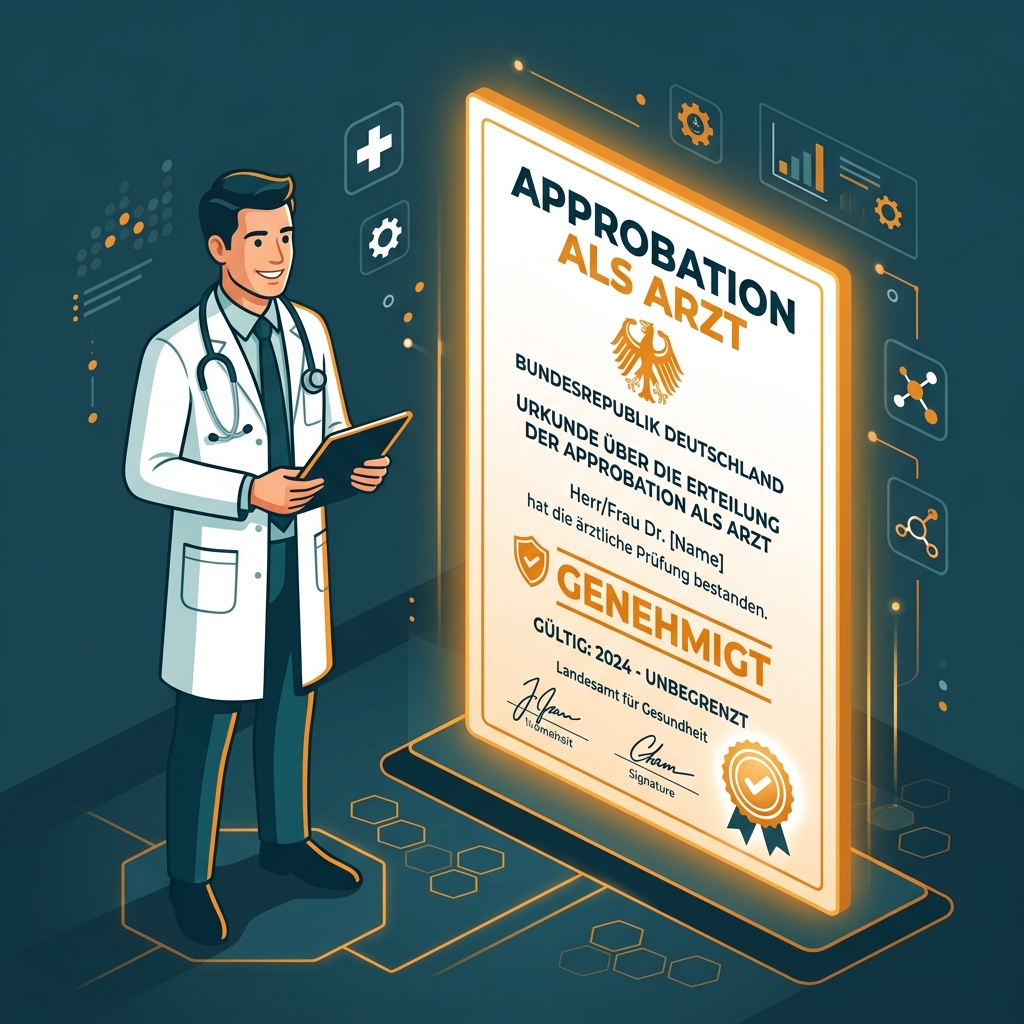
Approbation Timeline Germany: How Long Each Stage Really Takes
Doctor-led roadmap for Indian MBBS doctors
A realistic, stage-by-stage explanation of how long German medical licensing usually takes—from Indian document preparation to FSP, KP where required, Berufserlaubnis, Approbation and the first Assistenzarzt step.
2026 planning guideMBBS to GermanyTimeline varies by state
Direct answer: for most Indian doctors, the Approbation timeline in Germany is best planned as a 12 to 30 month project, depending on German language progress, document readiness, the chosen state authority, FSP dates, whether your medical degree is judged equivalent, and whether a Kenntnisprüfung is required. Some candidates move faster, but delays commonly happen because of incomplete documents, slow translations, authority backlogs, exam waiting periods, visa timing and weak job-readiness.
Table of contents
1. Who this Approbation timeline is for
This guide is for Indian MBBS doctors who want to work in Germany as doctors and eventually enter paid hospital-based Facharzt training. In Germany, “Medical PG” is not a classroom MD/MS seat. It is a structured employment pathway where you work as an Assistenzarzt under supervision, build specialty training time, and progress toward Facharzt. Before that clinical pathway becomes possible, you need the right licensing route: Berufserlaubnis in some cases, Fachsprachprüfung (FSP), equivalence assessment or Kenntnisprüfung (KP), and finally Approbation.
If you are still comparing countries, start with MedGermany’s PG in Germany after MBBS guide. If you already know Germany is your target, this article helps you understand the sequence, not just the dream. The most important mindset is simple: the German route is achievable, but it is document-heavy, language-heavy and state-specific. A realistic plan prevents panic later.
This is not a BDS dental Approbation guide and not a nursing Anerkennung guide. Dental Approbation, dental FSP/KP and nursing recognition follow separate rules and authorities. For MBBS doctors, the core medical licensing route is explained on MedGermany’s Approbation Germany page.
2. The realistic Approbation timeline at a glance
Official German sources make one point very clear: foreign medical qualifications are checked by the competent state authority, and the exact requirements depend on the federal state and your individual file. Recognition in Germany and Make it in Germany both describe the process as a professional recognition pathway, not a single national exam booking system. That is why two Indian doctors with similar MBBS degrees may still experience different waiting times.
| Stage | Practical time range | Main risk |
|---|---|---|
| German A1 to B2/C1 medical preparation | 8-18 months | Underestimating medical communication |
| Indian documents, apostille and certified translations | 1-4 months | Wrong sequence or expired certificates |
| State authority application and file check | 2-8 months | Backlogs and missing documents |
| FSP booking and result | 1-6 months after eligibility | Exam slots and insufficient speaking practice |
| Equivalence decision or KP route | 3-12+ months | Deficits found; KP waiting time |
| Berufserlaubnis/job/visa transition | 2-6+ months | Hospital contract, visa timing and state conditions |
Professional insight: do not plan the Approbation timeline as “finish B2, then think about documents.” The strongest candidates build language, documents, state strategy and clinical readiness in parallel. That is exactly where many Indian doctors save months without cutting corners.
3. Stage-by-stage: how long each part really takes
Stage 1: German language foundation
For most Indian doctors, language is the longest controllable stage. General German from A1 to B2 may take 8 to 14 months with disciplined study, but medical German is a separate skill. FSP is not only grammar. You must take a history, explain differentials, counsel a patient, write or present a medical report and communicate with a colleague in German. MedGermany’s FSP exam guide explains this distinction in more detail.
A common planning error is to count only certificate completion. In reality, your timeline depends on whether you can function in clinical German. A candidate who has B2 but cannot summarize chest pain, medication history, allergies and red flags clearly may still need months of FSP-focused training.
Stage 2: Documents from India
Document preparation can take one month if everything is already available and correctly named, or several months if you need university transcripts, internship records, registration certificates, good standing, experience letters, police clearance or fresh passport-related updates. Many states require certified German translations and specific formats. Some documents also need apostille or notarisation depending on the authority’s checklist.
Use MedGermany’s documents required for Approbation checklist before you start translation. Translating an incomplete or incorrect file is one of the easiest ways to lose money and time.
Stage 3: Choosing the German state and submitting the application
Approbation is handled by state-level authorities. The state you choose can influence document format, language proof, FSP process, whether a job offer is needed for certain steps, processing communication and practical waiting time. “Best state” is not universal. It depends on your profile, documents, German level, specialty aim, job geography and risk tolerance.
Once your application is submitted, the authority checks completeness. If something is missing, your timeline pauses. If the authority asks for clarification from India, a university letter or another certified copy, a two-week issue can become a two-month delay.
Stage 4: Fachsprachprüfung (FSP)
Most Indian doctors should expect FSP to be a central milestone. Booking time varies by state and chamber. Some candidates receive a date quickly; others wait longer because exam capacity is limited. After passing FSP, you are stronger for hospital applications and for temporary licensing options, but FSP alone is not full Approbation.
The practical timeline includes preparation, eligibility confirmation, slot booking, exam day and result processing. If you fail, the timeline extends because you need a new date and targeted correction of communication gaps.
Stage 5: Equivalence assessment, Defizitbescheid and KP
The authority assesses whether your medical training is equivalent to German medical training. If substantial differences are identified and not compensated by professional experience, you may receive a Defizitbescheid and need the Kenntnisprüfung. This does not mean your MBBS has no value. It means the German authority needs proof that your knowledge matches the required standard for safe medical practice in Germany.
The KP route can add several months to more than a year depending on state, preparation quality and exam availability. See MedGermany’s Kenntnisprüfung guide if your file is likely to enter this route.
Stage 6: Berufserlaubnis, job applications and visa movement
Some doctors work temporarily under Berufserlaubnis while progressing toward full Approbation, but the conditions vary. It is not a shortcut that removes exams or recognition. It is a restricted temporary permission linked to state rules, supervision and often a specific employer or region. MedGermany’s Berufserlaubnis explanation covers the limits clearly.
At this stage, your CV, interview readiness, specialty flexibility and German workplace communication start to matter. Licensing and employment are connected, but they are not the same thing. A doctor can be academically strong and still lose months because the hospital application strategy is weak.
4. What usually causes delays for Indian doctors
Common timeline mistakes
- Starting document collection only after finishing B2.
- Using non-certified translations when the authority requires certified German translation.
- Selecting a state only because someone online said it is “easy”.
- Preparing for FSP as a vocabulary test instead of a doctor-patient communication exam.
- Assuming Germany has no exams because NEET PG is not required for Facharzt entry.
- Applying to hospitals with a generic Indian CV instead of a German-style medical profile.
- Ignoring visa timing, blocked account or financial proof until a late stage.
Germany does not require NEET PG for Facharzt entry, but that should not be misunderstood as an exam-free pathway. The real barriers are German language, licensing documents, authority assessment, FSP, KP where required, visa rules and job readiness. A slower but correct route is better than a rushed route that produces rejections.
5. How to shorten the timeline safely
- Build a parallel calendar. Put language, documents, translations, state research, FSP preparation and CV preparation on one timeline.
- Choose the state strategically. Match your profile to the authority process instead of following random WhatsApp advice.
- Keep documents fresh. Some certificates have validity expectations, so do not collect everything too early without a plan.
- Prepare for FSP early. Start clinical German cases before the exam date is confirmed.
- Track authority communication. Reply clearly, submit complete files and keep copies of every document sent.
- Plan job readiness before Approbation. Use a German medical CV, focused cover letter and realistic specialty/city choices.
| If you are at this stage | Next best action |
|---|---|
| A1-A2 German | Understand the full route and begin document mapping. |
| B1-B2 German | Start certified document preparation and FSP case practice. |
| Documents ready | Choose state, check checklist and submit a complete file. |
| FSP passed | Strengthen hospital applications and prepare for equivalence/KP decision. |
6. India-specific planning notes for 2026
Indian doctors should also remember that the licensing timeline and the relocation timeline are connected but not identical. You may be preparing documents in India, waiting for a German authority response, improving German speaking skills, and comparing visa routes at the same time. If a state requests an additional university clarification or a fresh certificate, the fastest response is usually possible only when your Indian college, medical council registration details and personal records are already organised.
Financial planning matters too. Even though Facharzt training is paid once you are employed, the pre-employment phase can include German classes, exam fees, translations, courier costs, travel, accommodation deposits, insurance and visa-related financial proof. Do not build a timeline that assumes zero waiting time between FSP, KP, job offer and visa appointment. A practical calendar should include buffer months so that one delayed document does not collapse the whole plan.
Finally, keep your pathway medically focused. Hospitals are not only checking whether you have passed an exam; they want to know whether you can communicate safely, understand ward routines, write concise documentation, handle supervision, and adapt to German clinical culture. This is why Approbation planning should be combined with interview preparation, specialty clarity and realistic expectations about first jobs in smaller cities or less competitive departments.
7. How MedGermany helps
MedGermany helps Indian doctors turn the Approbation pathway into a realistic action plan. That includes profile assessment, document sequencing, state strategy, FSP/KP planning, CV and job-readiness guidance, visa-stage awareness and practical next-step clarity. The goal is not to promise a fixed month of success. The goal is to reduce avoidable delays and help you move through a complex German system with better preparation.
If you need a personalised sequence, use the Germany roadmap or speak to the team through MedGermany contact.
7. FAQ: Approbation timeline Germany
How long does Approbation take for Indian doctors?
Most Indian doctors should plan for 12 to 30 months from serious preparation to a stable licensing/job transition. The exact time depends on German level, document readiness, state authority processing, FSP, equivalence assessment and whether KP is required.
Can I get Approbation without Kenntnisprüfung?
It is possible if the authority considers your training equivalent or deficits are compensated, but many non-EU doctors are asked to take KP. The decision is individual and state-specific.
Does FSP give full Approbation?
No. FSP proves medical language ability. Full Approbation also depends on professional recognition, documents, health and reliability requirements, and equivalence/KP decisions.
Can I work before full Approbation?
In some cases, doctors may work with Berufserlaubnis under restricted conditions. It depends on the state, employer, documents and licensing status. It should not be treated as guaranteed.
Which stage should I start first from India?
Start German language and route planning first, but do not delay documents until after B2. The best approach is parallel preparation with a clear state and document strategy.
Is Germany still a good route if the timeline is long?
For many Indian doctors, yes, because Facharzt training is paid hospital-based employment and Germany has continuing demand for doctors. But the route suits candidates who can commit to German language, licensing discipline and realistic preparation.
Plan your Germany pathway with fewer avoidable delays
Planning your Germany pathway? MedGermany can help you understand your profile, documents, language stage, FSP/KP route, and next practical step.