Medical and Dental Career in Germany
BDS Dentist Career in Germany: A Deep Dive into Global Pathways vs. The European Advantage

BDS Dentist Career in Germany: A Deep Dive into Global Pathways vs. The European Advantage
Graduating with a Bachelor of Dental Surgery (BDS) is a monumental achievement, but it immediately presents a daunting question: how do you advance your clinical career without getting trapped in the bottleneck of the Indian postgraduate system? The intense competition for limited MDS seats leaves many brilliant dental minds searching for viable, financially sound alternatives overseas. If your goal is to build a highly lucrative BDS dentist career in Germany, we strongly advise looking toward the European healthcare system as your premier choice.
At MedGermany, we have guided countless dental professionals through the intricacies of international licensing. Let us explore in detail why choosing the Why Germany pathway outshines both the standard options available in India and the most highly marketed global dental alternatives.
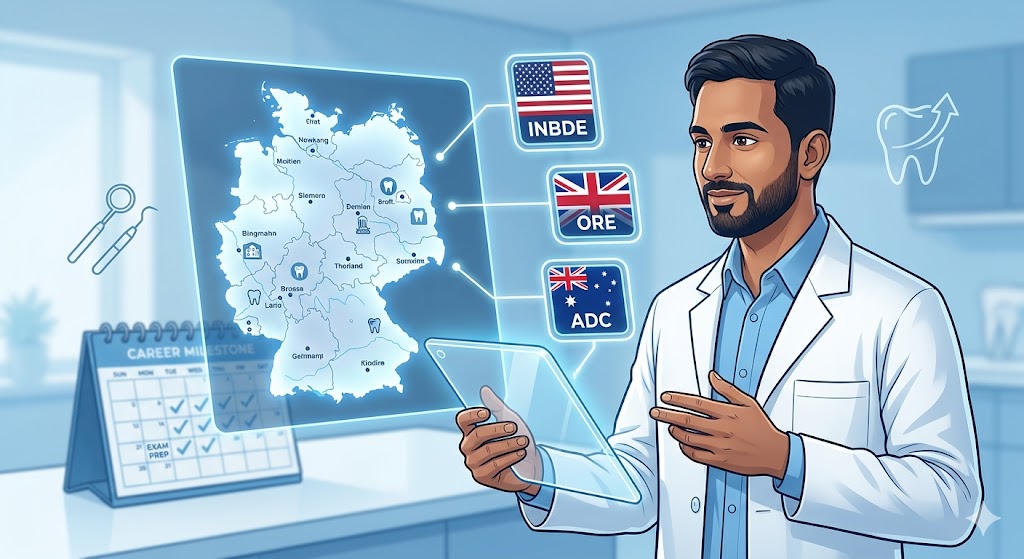
The Global Dental Exam Gauntlet: INBDE, ORE, ADC, and Beyond
Many BDS graduates instinctively look toward English-speaking countries for their next step. However, the dental licensing pathways for these destinations are fraught with immense financial burdens and systemic hurdles that are rarely discussed upfront. Let us review the stark reality of the most popular international dental exams.
- INBDE (United States): Passing the Integrated National Board Dental Examination is only the very first hurdle. International dentists must then gain admission to a highly competitive Advanced Standing DDS or DMD program. These programs often cost upwards of $150,000 to $200,000 in tuition fees alone, forcing candidates into massive debt before they even begin practicing.
- ORE & LDS (United Kingdom): The Overseas Registration Exam and the Licence in Dental Surgery are currently plagued by massive structural backlogs. Securing a seat for the ORE Part 1 or Part 2 is notoriously difficult. Candidates often wait years just to sit for the practical exam, losing valuable clinical time in the process.
- ADC (Australia): The Australian Dental Council exams are incredibly expensive and boast exceptionally low pass rates for the clinical portion. Candidates often spend thousands of dollars on preparatory courses with absolutely no guarantee of passing the rigorous practical assessments.
- NDEB (Canada): The National Dental Examining Board of Canada requires an arduous equivalence process. Similar to the United States, many internationally trained dentists are forced into expensive degree completion programs to practice legally, compounding the time and financial investment required.
Contrast these bottlenecks with the German system. The German model completely bypasses the need for re-doing your dental degree at a university. Once you secure your dental license, you apply directly to dental clinics for open assistant positions, just like applying for a standard corporate job.
The NEET-MDS Reality vs. The German Dental Pathway
The contrast between the Indian postgraduate dental system and the German model is equally staggering. In India, pursuing an MDS specialization requires years of grueling preparation for the NEET-MDS exam. Even with top scores, securing a clinical seat often involves exorbitant fees at private dental colleges, sometimes stretching into crores of rupees.
Germany flips this narrative entirely. When you prepare to work as dentist Germany from India, you enter a system designed for immediate clinical integration and continuous learning. There is no equivalent to the NEET-MDS exam for starting your career or pursuing further specialization (like Orthodontics or Oral Surgery). Instead, the focus is entirely on your language proficiency and validating your existing dental knowledge through state-run, standardized exams.
Financial Independence: German Dentist Salaries in 2026
One of the most compelling reasons to choose this route is immediate financial stability. Unlike the massive financial drain of preparing for the ADC or paying for a US Advanced Standing program, you are compensated fairly from day one of your clinical integration in Germany.
Based on the latest economic data and regional collective trends, the base salary for a first-year assistant dentist (Vorbereitungsassistent) in 2026 currently stands between €4,200 and €5,000 per month. This phase usually lasts about two years and serves as your formal introduction to the German healthcare system. Once you complete this phase and transition to a fully employed dentist (Angestellter Zahnarzt), your earning potential surges. Salaries rapidly scale to €6,000 to €8,000+ per month. Furthermore, many practices offer lucrative profit-sharing models (Umsatzbeteiligung) based on your individual clinical output, allowing highly productive dentists to earn significantly more.
Understanding How to Get Approbation in Germany
While the German system does not require a competitive academic entrance exam or a massive tuition fee, it does require a highly structured licensing process. Understanding exactly how to get Approbation in Germany is the foundation of your journey. Obtaining your dental Approbation Germany involves several non-negotiable steps:
- Language Mastery: The absolute prerequisite is reaching a solid B2 level in general German. This demonstrates your ability to integrate into society and understand complex texts.
- Fachsprachenprüfung (FSP): This is the specific dental language exam conducted by the regional dental chamber (Zahnärztekammer). It proves you can communicate effectively with patients, take accurate histories, and discuss treatment plans with colleagues. We provide detailed guidance to help you clear the FSP exam Germany on your first attempt.
- The Temporary License (Berufserlaubnis): In many states, passing the FSP allows you to apply for a temporary license valid for up to two years. This allows you to work and earn a salary while preparing for the final hurdle.
- Kenntnisprüfung (KP): Depending on the state's evaluation of your BDS curriculum (Gutachten), you will likely need to pass this dental knowledge test. It involves both a theoretical viva and a practical component (working on phantom heads) to ensure your skills align with German standards. We assist with thorough preparation strategies for the KP Exam.
- The Approbation: Upon passing the KP, you receive your Approbation, which is the final, permanent license to practice dentistry independently across all of Germany.
The Path Forward for Indian Dentists
Navigating this exact sequence requires meticulous planning, precise timing, and flawless documentation. Attempting to manage visa applications, deficit reviews, and exam registrations alone often leads to costly delays. To visualize your personal timeline and document workflow, we highly recommend reviewing our comprehensive Roadmap.
Choosing your post-graduation path is the most critical decision of your dental career. Escaping the endless cycle of entrance exams, exorbitant fees, and uncertain placements is entirely possible. By choosing Germany, you secure world-class clinical experience, access to cutting-edge dental technology, an exceptional standard of living, and total financial independence.
At MedGermany, we exist to bridge the gap between your Indian BDS degree and a thriving career in Europe. We handle the bureaucratic heavy lifting, map out your state-specific strategy, and guide your exam preparation so you can focus entirely on mastering the language and securing your clinical future.
Your Future in German Medicine Starts Here
Navigating the Approbation process requires precision. Let our consultancy map out your exact timeline, language strategy, and document workflow.
Prefer email? Contact our team directly to get started.