In this guide
- Defining "Medical Residency" in the German System
- Why We Strongly Recommend the German Pathway Over NEET-PG
- Core Entry Requirements: What You Actually Need
- How Long Is a Medical PG in Germany?
- The Training Process: What Daily Hospital Life Looks Like
- Salary Expectations: What You Will Earn
- Your Exact Step-by-Step Roadmap
- The Three Questions We Answer Every Week
- Crucial Considerations Before You Commit
- Your Future in German Medicine Starts Here
Complete 2026 Residency Guide
Bypass the immense pressure of the NEET-PG system. Discover the structured, fully salaried pathway to achieving your medical specialization (Facharztausbildung) in Germany.
Defining "Medical Residency" in the German System
In the German healthcare framework, a medical PG or residency is officially termed the Facharztausbildung. Board certification is known as the Facharzttitel. Only after completing your mandated hospital training and passing the final oral board examination can you legally practice as an independent specialist.
At MedGermany, when we consult with MBBS graduates internationally, we treat "residency," "PG," and "Facharztausbildung" as synonymous terms representing the exact same journey. The terminology changes, but the goal remains the same: world-class clinical specialization.
Why We Strongly Recommend the German Pathway Over NEET-PG
Through our extensive experience providing a clear, doctor-led roadmap for Indian MBBS graduates, we have identified several life-changing advantages over the grueling NEET-PG preparation cycle:
Discover more about the unparalleled lifestyle and career benefits on our comprehensive Why Germany guide.
Core Entry Requirements: What You Actually Need
Success requires strategic sequencing. We advise all our applicants to rigorously organize the following prerequisites in order:
- A recognized MBBS degree alongside a completed 12-month clinical internship.
- A valid permanent medical registration or license from your home country.
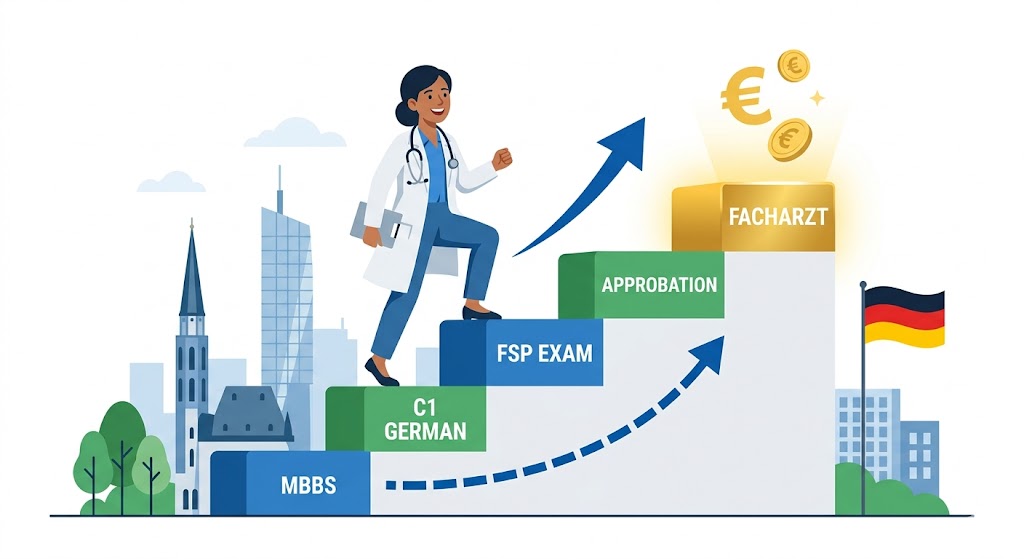
- Proven German language proficiency reaching B2 for general communication, followed by C1 Medizin to clear the mandatory FSP (Fachsprachprüfung).
- Successful completion of the KP (Kenntnisprüfung) if your MBBS was acquired outside the EU. This requirement varies depending on individual degree evaluations and the specific federal state.
- The ultimate acquisition of the Approbation (Full Medical License). Once issued, you are legally cleared to sign a residency contract.
How Long Is a Medical PG in Germany?
A critical error many applicants make is underestimating the duration of surgical and internal programs. You must plan your finances, language acquisition, and support systems accordingly. Below is the official breakdown of training durations by specialty.
48 Months (4 Years): Pre-Clinical Sciences
Biochemistry (Biochemie), Physiology (Physiologie), Anatomy (Anatomie).
60 Months (5 Years): Primary & Specialized Clinicals
Family Medicine, Anesthesiology, Ophthalmology, Obstetrics & Gynecology, ENT, Dermatology, Human Genetics, Pediatrics, Child & Adolescent Psychiatry, Microbiology/Virology, Nuclear Medicine, Neurology, Pharmacology, Phoniatrics, Physical & Rehabilitative Medicine, Psychiatry & Psychotherapy, Psychosomatic Medicine, Radiology, Forensic Medicine, Radiotherapy.
72 Months (6 Years): Advanced Surgery & Internal Medicine
Transfusion Medicine, Urology, General Surgery, Vascular/Cardiac/Pediatric/Plastic Surgery, Orthopedics & Trauma Surgery. Core Internal Medicine including subspecialties: Angiology, Endocrinology, Gastroenterology, Hematology & Oncology, Cardiology, Nephrology, Pneumology.
The Training Process: What Daily Hospital Life Looks Like
You will train as an Assistenzarzt under the direct supervision of certified specialists in university, regional, or private network hospitals. Your clinical progression is meticulously tracked against the official training catalog and recorded in a physical or digital Logbuch.
Every rotation, ultrasound, surgical procedure, and intensive care shift must be documented and signed off by your supervisor. This documentation discipline is non-negotiable. At our consultancy, we coach doctors to adopt a "log as you go" mentality to prevent administrative bottlenecks prior to their final board exams.
Salary Expectations: What You Will Earn
As a highly realistic planning frame for 2026, resident doctors generally see base salaries starting around €4,850 gross per month in Year 1, scaling up to roughly €6,340 gross per month by Year 5 or 6.
Crucially, this base figure does not include on-call payments, night shift supplements, weekend allowances, or occasional department bonuses. Actual compensation depends on your specific hospital wage agreement (Tarifvertrag) and your monthly duty roster. We actively assist our clients in deciphering these contracts to accurately model net take-home pay after taxes and social insurance deductions.
Your Exact Step-by-Step Roadmap
To view the entire structured workflow of this process, explore our complete Medical Residency Roadmap. Below is the essential progression:
- Orientation & Specialization Choice: Understand the systemic pros and cons while targeting two to three realistic specialties.
- Language Acquisition: Achieve B2 general German, then transition aggressively into C1 Medizin to prepare for the FSP.
- Document Attestation: Execute certified translations strictly through court-sworn translators.
- State Selection & Application: Submit files to your chosen state authority for review.
- Clinical Hospitation & FSP Courses: Engage in an observership to improve hospital readiness and deeply contextualize exam scenarios.
- Visa Procurement: Secure a national visa (Type D) backed by hospital invitations or intensive language course enrollments.
- Clear the FSP: For deep preparation insights on this clinical language exam, read our FSP Exam Explained Guide.
- Clear the KP: The knowledge exam required based on your degree evaluation. Review our Kenntnisprüfung Knowledge Exam Guide for syllabus details.
- Approbation & Contracting: Receive your full license and sign your employment contract as an Assistenzarzt.
- Residency Execution: Complete rotations, fulfill Logbuch quotas, and undergo annual evaluations.
- The Final Exam: Pass the Facharztprüfung to achieve consultant status.
The Three Questions We Answer Every Week
"Exactly how many years does a medical PG in Germany take?"
It requires four to six years depending entirely on your chosen discipline. Pre-clinical fields are shorter, whereas surgical and internal subspecialties consistently require 72 months of logged clinical practice.
"How long will I be isolated from my family and friends back home?"
You will reside in Germany for the duration of your training. However, residents are entitled to approximately 30 days of paid annual leave. Many of our candidates structure their duty rosters to accommodate one or two extended trips to their home country per year. Planning is key: call schedules dictate your flexibility, so coordinate family events well in advance.
"What is the long-term financial trajectory?"
Beyond the residency base of €4.8k to €6.3k per month, achieving your Facharzttitel unlocks consultant-level compensation, performance bonuses, and highly lucrative private practice opportunities that significantly multiply your lifetime earnings.
Crucial Considerations Before You Commit
- Language is Non-Negotiable: Your patient interactions, legal documentation, and board exams are conducted entirely in advanced medical German.
- Bureaucratic Variability: Processing timelines, document scrutiny, and exam waitlists differ drastically from state to state.
- Financial Runway: You must budget capital for high-level language courses, sworn translations, visa applications, relocation costs, and a living buffer of 3 to 6 months prior to earning your first paycheck.
- Cultural Adaptability: You are entering a new healthcare system and a distinct work culture. Give yourself grace and time to acclimate.
In our dedicated one-on-one consulting work with international doctors, the candidates who succeed fastest are those who plan early, select their target federal state strategically, and prepare for exams with clinical simulations rather than basic grammar drills. Explore more success strategies on our News and Insights page.